Milky Way Exposure & Stacking Manual
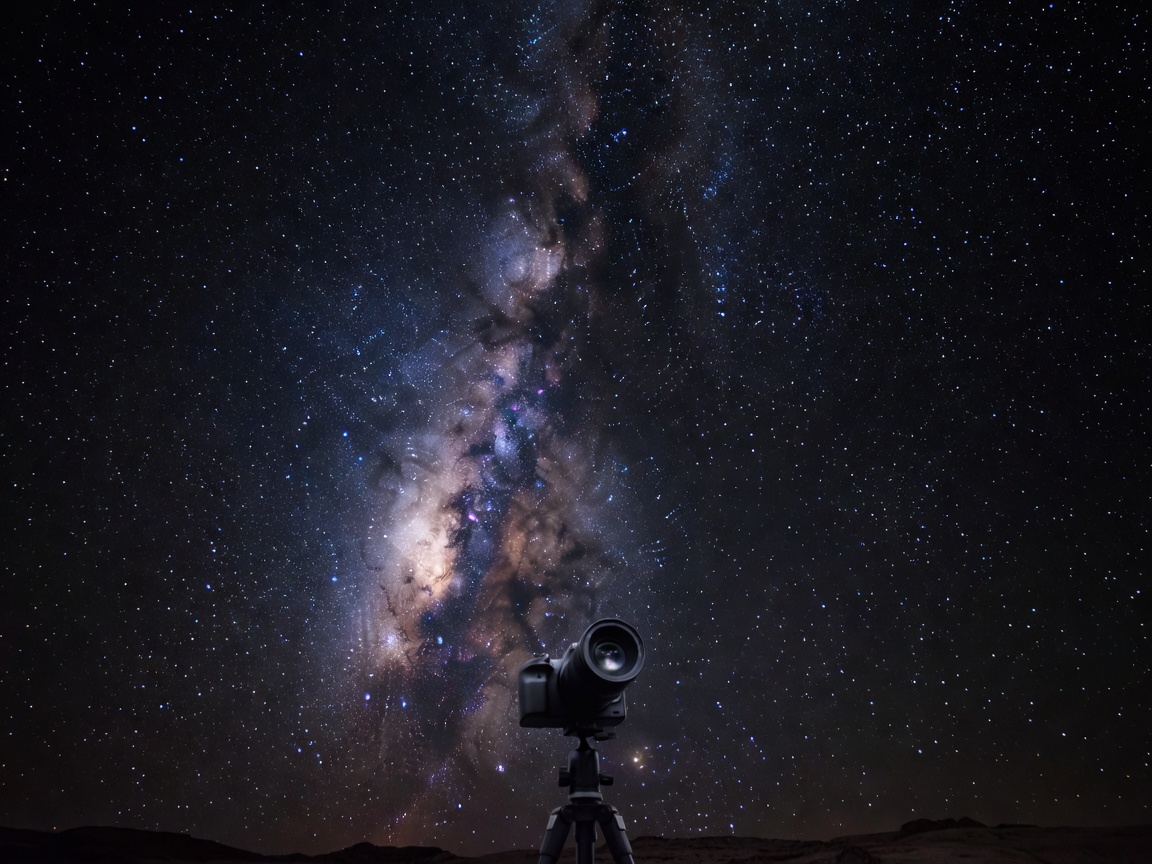
Capturing the rich dust lanes and faint emission regions of the Galactic Core requires balancing exposure length with camera sensor noise. Because Earth rotates, static camera tripod setups are subject to star trailing if exposures exceed threshold limits.
Calculating the NPF Rule
While the old "500 Rule" provided rough estimates, modern high-resolution sensors require the NPF Rule, which takes aperture (N), pixel pitch (P in microns), and focal length (F in mm) into account to prevent pinpoint stars from trailing:
Exposure Seconds = (35 × Aperture + 30 × Pixel Pitch) ÷ Focal Length
The Power of Image Stacking
Digital camera sensors introduce thermal noise, read noise, and fixed-pattern noise into low-light exposures. Stacking multiple exposures increases Signal-to-Noise Ratio (SNR) by the square root of the number of frames.
Essential Calibration Frames
- Light Frames: The primary photos containing target light and sensor noise.
- Dark Frames: Exposures taken with the lens cap on at the exact same temperature and ISO as light frames to isolate thermal sensor glow.
- Flat Frames: Photos of an evenly illuminated surface to eliminate optical vignetting and sensor dust shadows.
- Bias / Offset Frames: Ultra-fast exposures (1/8000s) capturing digital readout noise.